Airlines: how to communicate when everything becomes uncertain?

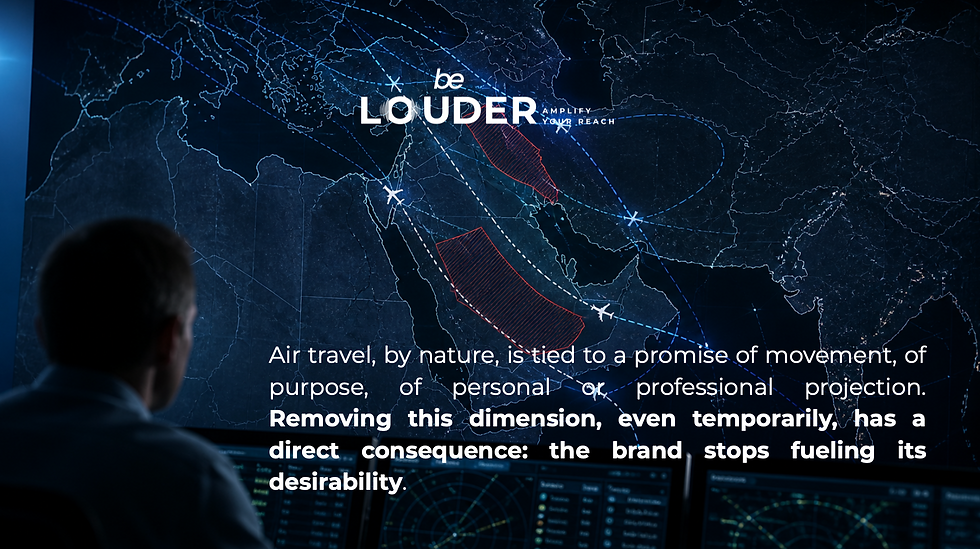
The airline industry is not simply facing a cyclical crisis. It is entering a phase of structural instability. Geopolitical tensions in the Middle East are not isolated events: they are durably reshaping flight paths, extending travel times, and increasing operational complexity. The rise in fuel costs is not just a financial variable: it is altering economic balances, pricing strategies, and even the way airlines structure their offer.
In this context, decisions are no longer made within a stable framework. They are made in an environment that is shifting, sometimes contradictory, and above all, often uncertain. And yet, in many cases, airline communication continues to be designed as if that framework had not fundamentally changed.
This is where the issue lies. In an unstable environment, communication is no longer a simple relay. It becomes a direct driver of perception and therefore of trust.
The risk is not communicating less. It is creating a gap with reality.
In uncertain situations, organizations naturally seek to protect themselves. Some reduce their communication to avoid sharing information that may evolve too quickly. Others maintain a stable narrative to avoid signaling deterioration.
Both approaches are understandable.
But they produce the same outcome: a gap between what is said and what is experienced. And that gap is far more visible today than it used to be. Why? Because passengers no longer rely solely on the airline’s message. They constantly compare:
what is announced
what they observe externally
what they read elsewhere
what they experience themselves
As a result, communication can no longer be assessed in isolation. It is immediately put into perspective.
A message that feels too polished in an unstable context creates doubt. A lack of explanation in a complex situation creates anxiety. An unchanged promise in a changing environment creates mistrust. What undermines credibility first is not the mistake, it is the gap. And once that gap is established, it is difficult to close.
The real demand is not emotional. It is cognitive.
A common misconception is that, in times of tension, passengers primarily expect reassurance.
This view is incomplete.
Passengers are trying to understand the situation they are in. They want to know why their flight has been modified, why certain routes are being diverted, and whether these decisions are temporary adjustments or structural constraints. This need for understanding comes before reassurance. And it is what ultimately determines trust.
If a situation is understood, it can be accepted.If it is not, it is endured. This implies a fundamental shift in communication. It is no longer just about producing messages. It is about structuring information that is intelligible.
This requires:
prioritizing information (what is certain vs. what is evolving)
contextualizing decisions (short-term vs. structural)
clarifying constraints (what is within the airline’s control vs. what is not)
Communication that brings clarity reduces perceived uncertainty. Communication that oversimplifies increases it.
Abandoning aspiration is a misdiagnosis.
Under operational pressure, some airlines may be tempted to shift toward purely functional communication : practical updates, schedule adjustments, operational explanations.
This shift makes sense in the short term but it is based on an incomplete diagnosis.
An airline is not judged solely on its ability to transport.It is also judged on its ability to project. Air travel, by nature, is tied to a promise of movement, of purpose, of personal or professional projection. Removing this dimension, even temporarily, has a direct consequence: the brand stops fueling its desirability. Conversely, maintaining a purely aspirational narrative without acknowledging the context creates a second issue: dissonance.
Passengers then perceive two conflicting signals:
a constrained reality
an unchanged narrative
And that dissonance undermines credibility.
The challenge, therefore, is not to choose between information and inspiration. It is to build a credible articulation between the two. This means:
integrating constraints into the narrative without destroying it
maintaining projection without denying reality
accepting communication that is less “perfect,” but more accurate
Aspiration does not disappear: it evolves.
Communication becomes a system, not a message.
In a stable environment, communication can operate through campaigns. In an unstable one, that model reaches its limits. Because reality evolves faster than content production cycles. A message validated at a given moment can become partially outdated within days.
This requires a fundamental shift. Communication must be seen not as a sequence of messages, but as a system.
A system in which:
operational teams continuously feed information
communication teams rapidly translate it
decisions are made at a pace aligned with instability
In practice, this means:
shortening validation cycles
accepting less rigid messaging
prioritizing responsiveness over perfection
More importantly, it implies a change in status : communication can no longer be a support function.It becomes a steering function. It ensures coherence in an environment that, by nature, lacks it.
After the crisis: what matters is not what was said, but how it was said.
Periods of instability do more than disrupt operations. They reshape brand perception. An airline that over-communicates without coherence will be perceived as opportunistic. One that under-communicates will be perceived as opaque. One that maintains a disconnected narrative will be perceived as out of touch.
Conversely, those that:
explain their decisions
acknowledge their constraints
maintain consistency over time
will build something different : trust. And that trust becomes decisive when a return to relative normality occurs.
Because at that point, the market does not reorganize solely around price or product. It reorganizes around perception. Airlines that were perceived as clear during the crisis will be seen as credible after it.
The others will have to rebuild. And rebuilding takes time.
Conclusion.
In an unstable environment, communication can no longer be treated as an additional layer. It becomes a structural component of the relationship with passengers. Airlines are no longer judged solely on their ability to operate. They are judged on their ability to make their reality understandable. The difference no longer lies in the quality of the message. It lies in the consistency between what is said and what is experienced. And in today’s airline industry, that consistency is no longer a communication issue. It is a matter of trust.
Julien Pitassi.




Comments